
Estimated reading time: 8 minutes
Warehouse automation is one of those investments that smart businesses make to help them scale. But that investment may look a little different when that business is a 3PL. Sure, 3PLs want to grow and scale, just like any other business; but doing so is not just a matter of adding staff or machines, but of learning how to control the variability inherent in the business.
The challenge is that, for 3PLs, growth rarely arrives in neat, predictable increments. Volume surges with seasonal demand, retail promotions, and new client onboarding. One month the highest priority is absorbing peak throughput without missing SLAs; the next, it is recalibrating labor and workflows as volume pulls back.
The operational question underneath all of this is simple, but always in the back of mind for 3PL managers: How much can the system actually handle, and under what conditions?
Operational leaders spend a significant amount of time thinking about real capacity in concrete terms:
- How many orders can move through the facility per hour or per shift?
- Which carton sizes flow cleanly and which potentially introduce issues?
- Where do the handoffs slow down during volume spikes?
- How much staffing flexibility exists before service levels begin to strain?
The ability to answer those questions with confidence, rather than estimates or gut feel, determines whether a 3PL can responsibly take on new business without destabilizing daily operations.
Hard-to-Predict Operations Are More Complex to Scale
In many facilities, the answer to these capacity questions still live in spreadsheets and tribal knowledge. That may suffice during more stable periods, but when peak season or a popular promotion hits, the answers may be up for grabs…and processes will tend to become more reactive.
For many 3PLs, this means adjusting staffing levels on short notice, with supervisors spending more time managing exceptions than improving workflow. And while there might be a great team in place that performs well under pressure, the operation itself becomes harder to predict, and thus harder to control. The chances of violating an SLA increase, and growth decisions become cautious rather than strategic. In short: Manual processes and tribal knowledge force operators into constant rebalancing rather than forward planning—and this is where growth slows.
Automation as a Control System: A Practical Example
In high-variability fulfillment environments, automation is often misunderstood as a way simply to move faster. In practice, its more important role is stabilizing the system. If variability comes from manual pacing, handoffs, and workarounds, well-designed automation establishes a consistent flow and makes constraints visible instead of latent.
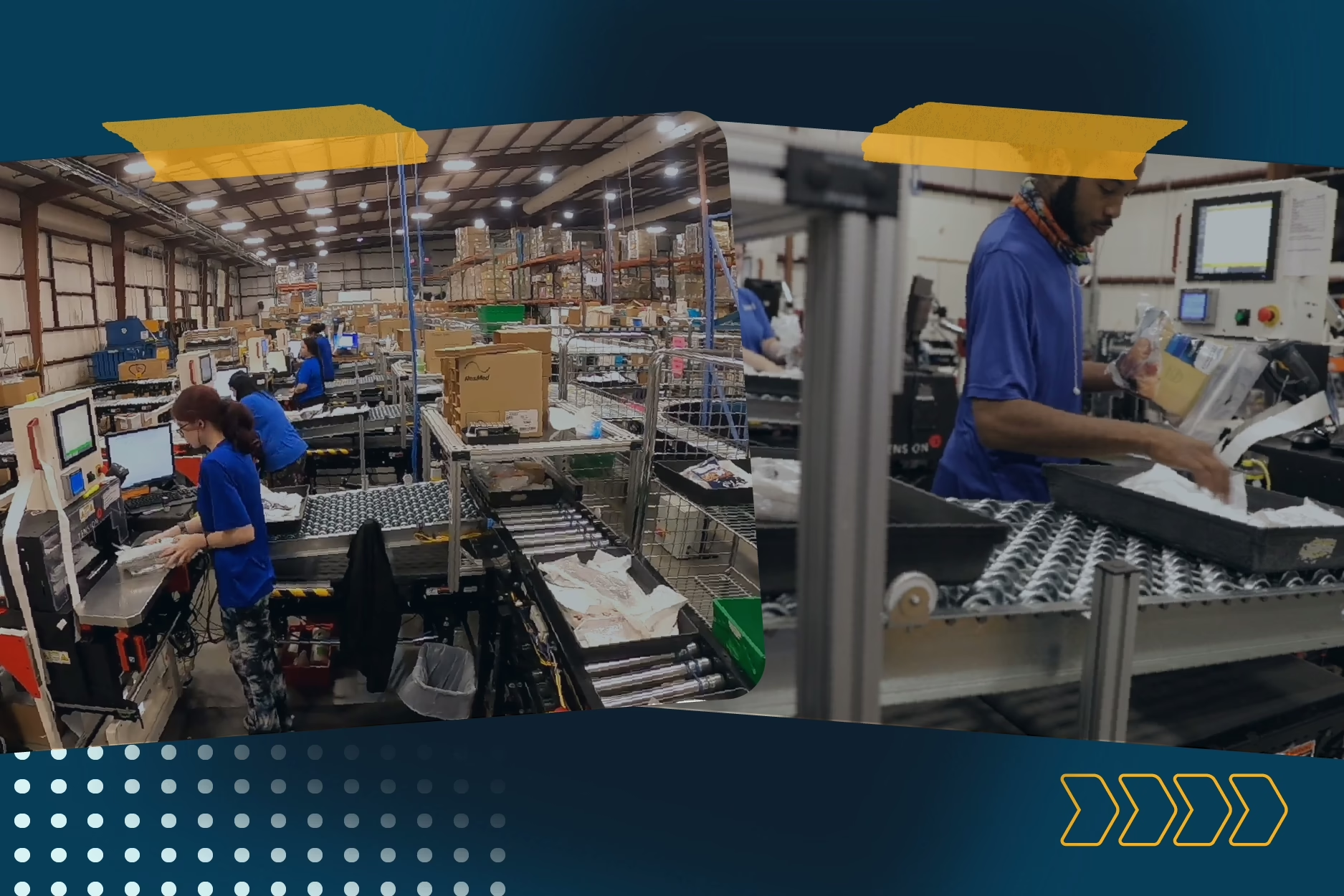
Packing stations are a good example of where this happens. We have seen plenty of clients where packing was its own kind of bottleneck: The stream of packages would end at a cluster of manual ship stations, where 6 to 8 workers would pack each order, weigh, apply labels, etc. This led to congestion and increased the chances that an error would occur. When order velocity increased, more people and more stations needed to be added, which meant more people on the team working almost on top of one another. That just made the congestion and the propensity for errors worse.
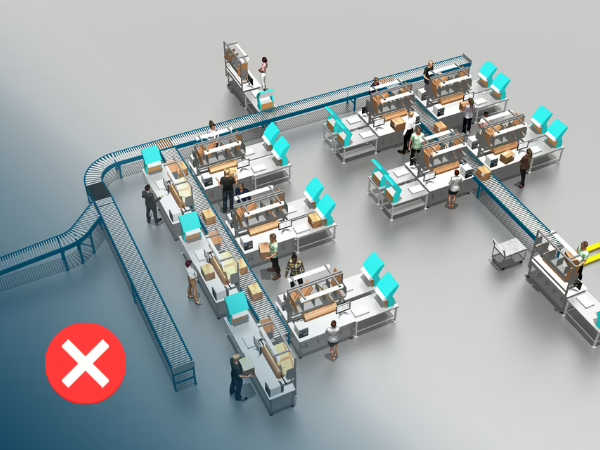
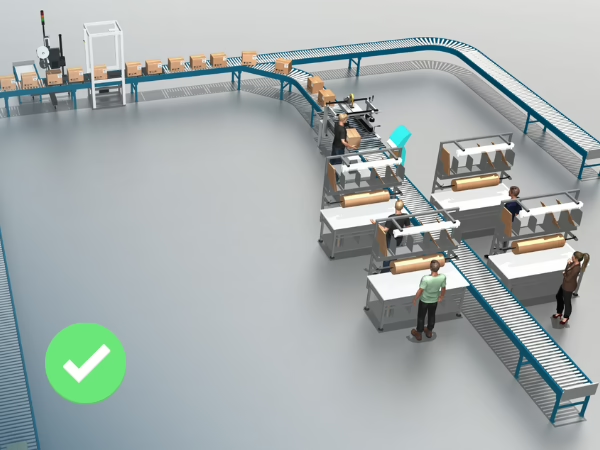
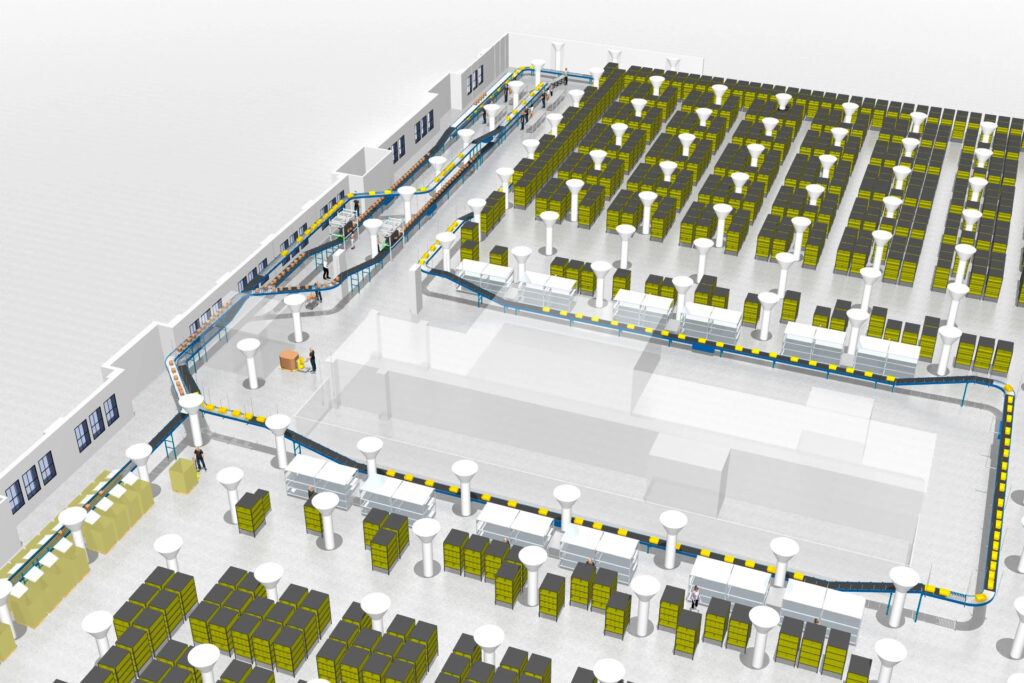
An automated solution might look like this: A conveyor brings orders into a single line. Machines scan each package, weigh it, and apply a label for shipping. A much smaller team is needed at the end of the process, which can focus on the final QA check and sealing.
In this example, the benefits are not just speed, but an increase in control:
- The exact speed of the conveyors and machines is known, so maximum throughput is easy to calculate.
- If throughput is not sufficient, it is a straightforward fix to add another machine, and managers will know precisely what that added capacity will be.
- Packages that would create exceptions (due to large size, irregular shape, custom labeling requirements, fragility, etc.) can be easily routed to another area to be dealt with manually, leaving the majority of orders to be dealt with normally and quickly.
- With right-fit automation tools, the team can focus on high value procedures (like quality control) without being burdened by the repetitive tasks (like weighing and dimensioning).
What an Automation Solution Looks Like in Practice
In a typical engineered shipping system like StreamTech’s Sprinter platform, throughput is designed and validated, not estimated.
For example, we specify details like:
- The operating throughput (example: 15 to 18 cartons per minute)
- Conveyor widths and roller density that accommodates your package range
- Known exception handling and sortation routing logic
- Software connection (WCS to TMS/WMS) and expected response times
That means a 3PL can quickly translate system performance into business planning:
- 15 CPM = 900 cartons per hour
- Two shifts = 14,000+ cartons per day
- With clear size boundaries
- Easy for your technical team to monitor the success
Instead of guessing whether a new client’s order profile will fit the operation, leadership can evaluate it against engineered capacity.
At StreamTech, automation does not begin with equipment. It begins with definition. Every project starts with a Functional Specification Document, or FSD.
This document outlines in precise detail how the system will operate – software behavior, controls logic, mechanical design, dimensional constraints, throughput performance, electrical requirements, and integration points. It establishes the operating boundaries of the system before implementation begins. This is where automation becomes a strategic planning tool. A well-developed Functional Specification Document (FSD) does far more than guide installation.
It defines:
- Throughput rates under real operating conditions
- Carton size ranges and weight limits
- Exception scenarios
- Staffing touchpoints
- System constraints and expansion paths
For 3PL operations, the FSD becomes a cheat sheet for growth. It answers questions like:
- Which customer profiles fit this facility perfectly?
- What volume can we absorb without adding labor?
- Where will capacity cap out?
- How easily can we expand throughput when needed?
Instead of onboarding customers and discovering fit under pressure, 3PLs can qualify business confidently before contracts are signed.
Real Customer Results:

“Conveyance automation has transformed how we move product through our facilities, giving us the agility to scale up during seasonal spikes and flex down during slower periods. We’re able to process a higher volume of packages while maintaining tight service levels without sacrificing accuracy. It’s been a key driver of both operational excellence and sustainable growth at DCL Logistics.”
Brian Tu
Chief Revenue Officer, DCL Logistics
Scaling Without Losing Operational Control
When capacity is governed by engineered systems rather than manual balancing, scaling becomes more controlled. Throughput becomes measurable rather than inferred, and volume increases can be absorbed without immediately triggering emergency staffing.
At StreamTech, we often see this shift change how operators evaluate expansion and customer commitments. When capacity is visible and predictable, leaders can asses new volume based on real system behavior rather than assumptions. Carton sizes, flow rates, constraint locations, and staffing requirements become known quantities instead of variables that must be discovered under pressure. That clarity enables more confident decisions about onboarding new clients or absorbing seasonal demand.
Designing Automation for Variability, Not Averages
One of the most common pitfalls in automation planning for a 3PL is designing around average volume rather than operational variability. Averages rarely reflect how 3PL facilities actually behave; seasonal peaks, promotions, and onboarding waves drive 3PL warehouse activity to a much greater extent than in warehouses operated on behalf of a single company.
Effective automation strategies typically start by identifying where variability causes the most friction, and where bottlenecks tend to emerge under heavier loads. In many facilities, those can be found in areas such as:
- Putaway and slotting. Higher volumes means more inbound items, and putaway can cross paths with picking. Rushing putaway can mean fewer quality checks and more mis-slotting of items.
- Picking. When picking is done manually, pick paths are sub-optimal, increasing time in the aisles and slowing throughput. This creates congestion when order velocity is high, but may mean idle workers when things calm down.
- Packing and “value added” services. Again, packing can create congestion when everything is done manually. Adding more labor only compounds issues.
- Shipping. SLAM (Scan, Label, Apply, Manifest) processes tend to become more error-prone as more speed is needed. Fortunately, they are also easy to automate and integrate into other systems.
- Exception handling. When exceptions can be identified early and removed from the primary workstream, flow can be maintained much more easily.
A Practical Lens for Evaluating 3PL Automation
For 3PL operations, automation decisions are, ultimately, risk decisions. The meaningful question is not how fast a system can run under ideal conditions, but how well it maintains control when conditions change.
Systems that perform well in volatile environments tend to:
- Protect SLAs during volume swings
- Reduce reliance on reactive labor scaling
- Make capacity transparent and governable
- Operate effectively within real facility constraints
- Improve consistency at natural bottlenecks
This is the lens we bring when evaluating fulfillment automation for high-variability operations (like your typical 3PL warehouse). The objective is not automation for its own sake, but systems that preserve operational confidence as the business grows and evolves.
If your operation is navigating rising volume, seasonal volatility, or increasing service expectations, it may be worth stepping back and assessing whether your current systems truly support controlled scaling, or whether they still depend too heavily on manual intervention when pressure rises.